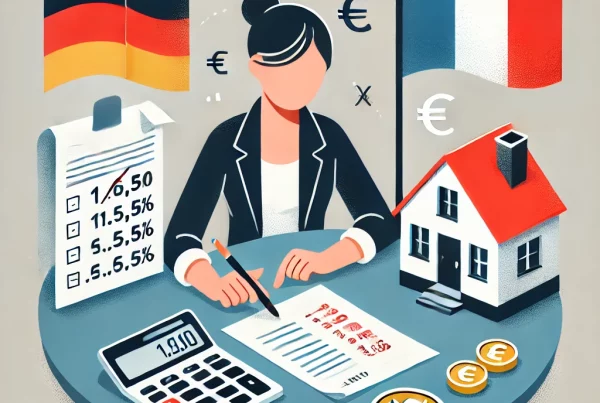

If you live in Germany, you've probably already said to yourself: «I'd like to buy, rather than throw my rent out the window...».
But when you think about it a little more, the questions follow:
- With real estate prices in Munich, Hamburg, Frankfurt or Berlin, is it really profitable?
- And above all, can I afford it?
- How many years do you need to stay in the market before buying becomes more attractive than renting?
- And if I decide to return to France, what's going on?
- Could I make a purchase today block financially for other projects?
All these questions - and many more - are holding you back from taking the plunge.
👉 In this article, we take a step-by-step look at the situation, to help you see clearly and make an informed decision: buying or renting, what's the best option for you as a French expat in Germany?
Buy or rent? Comparative figures
Today, rent an 80 m² apartment in Munich costs about 1,600 per month (Kaltmiete, excluding utilities), depending on the district.
If you were planning to buy the same property, you would need to budget around 640 000 €, approximately 8 000 €/m².
By way of comparison :
| City | Average rent (80 m²) | Estimated purchase price |
| Munich | 1600 € / month | 640.000€ |
| Berlin | 1400 € / month | 450.000€ |
| Frankfurt | 1500 € / month | 560.000€ |
| Hamburg | 1400 € / month | 480.000€ |
Case in point: the Munich scenario
Let's take a simple example to illustrate the difference between buy and rent the same accommodation in Munich.
- Purchase price : 640 000 €
- Acquisition costs (notary, tax, agent) : ≈ 57 600 € (i.e. 9 %)
- Average monthly payment (no deposit, current rate) : ≈ €3,200 / month
- Repayment term : about 27 and a half years (classic in Germany)
Scenario 1: you buy
- Over 27.5 years, you repay your loan and become a full owner.
- Assuming a moderate real estate market revaluation of +2.8 %/year, your initial property (€640,000) could be worth around 1.4 million euros at the end of the credit period.
- Once the loan has been repaid, you'll have €3,200 a month “freed up” to invest in other areas.
- What's more, resale is exempt from capital gains tax.
Scenario 2: You remain a tenant
- You keep your 57,600 € acquisition costs, which you can place right from the start.
- And every month, you save the difference between the monthly payment on a purchase (€3,200) and your rent (€1,600), i.e. 1,600 invested monthly.
- By investing this amount at a net yield of 5 %/year, your capital would reach approximately 1.3 million euros after 27.5 years.
Result: draw?
In the end, the two scenarios hold together:
Visit owner has real estate assets estimated at €1.4 million.
Visit tenant-investor has financial capital of around €1.3 million.
But all this is based on assumptions: rates, inflation, real estate market trends and financial returns.
And no one knows what the future holds.
So what does this mean?
Numbers only tell part of the story. Beyond the math, other criteria come into play.
Buying or renting in Germany: non-financial criteria to consider
Owner:
- benefits from stability You don't have to pay a rent increase, and you can't be kicked out of your own apartment (some tenants lose their home when the landlord wants it back!).
- can resell without capital gains tax if he lives there
- once the loan has been repaid, the customer has a savings capacity of €3,200/month.
But it loses in flexibility :
- what happens in the event of unemployment, Elternzeit or career mobility?
- his wealth is concentrated in a single asset (his principal residence); ;
- it has fewer cash for other projects (children's education, rental investment, retirement, etc.).
⚠️ ...and assumes risks that the lessee has not
Being an owner also means bear certain risks alone :
- Work and maintenance Roofing, boilers, facades, condominiums... expenses that are sometimes unpredictable and often costly.
- Interest rate trends In Germany, the interest rate on a mortgage is generally fixed over 10 years (Zinsbindung).
See our article: Mortgages in Germany: 5 differences from France - Expat Finances - Market risk If you have to sell in an unfavorable environment, you may lose part of your stake.
Visit tenant, The homeowner, on the other hand, escapes these vagaries: he controls his budget, can't afford structural or financial unforeseen events, and remains mobile. And that's important too: these days, it's rare to live in the same place all your life. Which brings us to another question:
After how long does buying become more attractive than leasing?
What happens in the early years
In our scenario, in the first few years, the :
- mainly pays interest, so he repays little capital; ;
- immobilized nearly €58,000 in acquisition costs (“non-recoverable” money) ;
- and pays monthly 1,600 more than the tenant.
The tenant :
- keeps its freedom,
- invests €1,600 per month at 5 % net,
- plus his starting salary of €57,600.
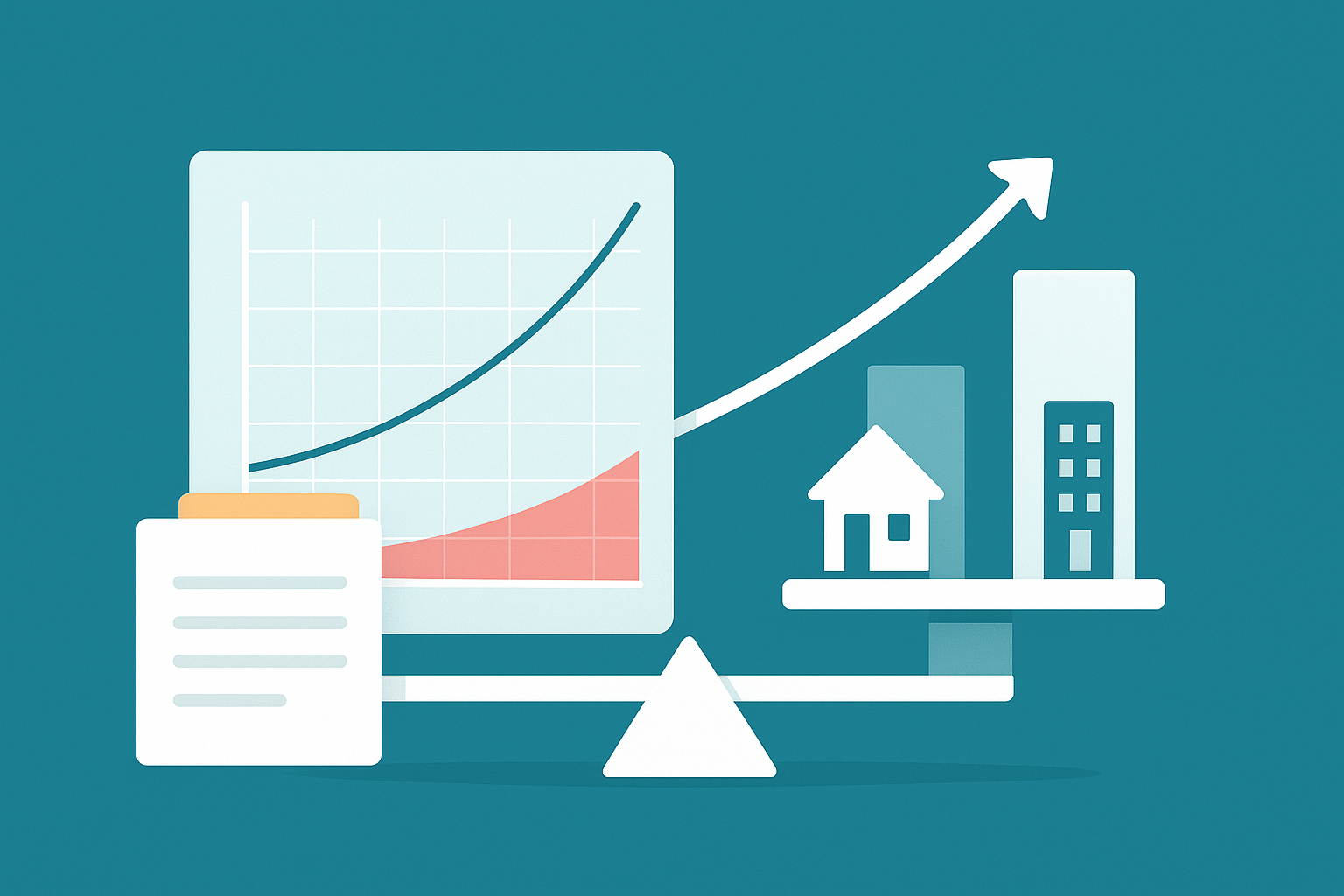
👉 On the First 5 to 7 years, the advantage is clearly with the tenant, This is because the net value of the property purchased is still less than the return on the savings invested.
The effect of time: depreciation and valorization
As time goes by :
- the buyer repays more and more capital; ;
- the interest portion of your monthly payment decreases; ;
- and its property increases in value (here +2.8 %/year).
From 10 years, accumulated capital repayments + the property's unrealized capital gain begins to exceed the tenant's financial returns. In fact, as always, real estate is a long-term investment. But life is not always a linear plan: a professional project, an opportunity or simply the desire to return to France (or move to another country) can change everything.
What happens if you decide to return to France?
This is a very common situation.
Many expatriates, after several years in Germany, wish to return to France, where they often buying a home. And now a new question arises:
“Will my purchase in Germany slow me down?”
If you return to France, you have two options: resell or rent out your German property.
Reselling your property in Germany
- If the resale takes place “too soon”, your property has perhaps not yet taken on sufficient value to compensate for acquisition costs (often 8 to 12% of the price).
- If it was your principal residence, the potential capital gain is not impossible.
Keep your property and rent it out remotely
- You become non-resident owner in Germany, with specific tax obligations.
- You need manage tenants remotely
- Visit rent does not always cover the entire monthly payment, But that doesn't mean it's not profitable in the long term - your capital continues to build.
Buying a home in France after your return
We need to ask ourselves two very concrete questions:
- Do you have’enough input to buy in France without reselling your German property?
- Do you have the financial capacity repay a new loan while maintaining a loan (and possibly a deficit) in Germany?
You'll then know whether you can afford not to resell your property in Germany. If you can't afford to keep the German property, it may be a good idea to wait before buying in France, rather than rushing to resell in Germany.
🧭 In a nutshell
It all depends on your personal situation and your horizon.
But if you're thinking of staying under 10 years in Germany, it can be safer not to buy, to maintain your flexibility and future investment capacity.
There are also plenty of other ways to make your money grow, without necessarily immobilizing it in stone - the key being to don't let it sleep... or spend it without a plan.
We can also advise you on the most attractive investments in Germany. That way, you can decide what's most relevant to you. Contact Expat Finance - Expat Finances
Finally, we've also compiled the most frequently asked questions about buying real estate in Germany, in the hope that these answers will help you move forward with your project.
FAQ
Watch this video: Buying a property in Germany: the various steps
On the program:
00:00 Preparatory work
00:41 Property search
03:55 Search for financing
06:27 Loan contract and signature at the notary's office
10:33 Price payment
13:36 Property transfer
In Germany, there is no strict debt ratio like the French “33 %”.
Banks tend to evaluate repayment capacity based on net income, professional stability and property value.
They check that the living expenses is sufficient to cover current and unforeseen expenses.
Most banks require at least 10 % of the purchase price in personal contribution. To this must be added the acquisition costs (Grunderwerbesteuer, Notar, Makler: in total ~10% depending on the Länder). So plan on 20%.
You must present a solid case stable income, permanent employment contract, sound banking history.
The interest rate is often fixed for 10 to 15 years (Zinsbindung).
After this period, it will be renegotiated according to market conditions.
Between signing the contract at the notary's office and handing over the keys, allow for about 2 to 3 months.
To buy : Grunderwerbsteuer (acquisition tax): 3.5 to 6.5 % (varies from one Land to another, look here for your Land)
Then, every year, you pay the Grundsteuer (property tax). The amount is quite low compared with France.
Since this is your principal residence, there is no no income tax (you don't receive any rent!) - this means that you can't take advantage of tax deductions.
Yes, it's possible. The contract of sale mentions the two purchasers and the division of ownership (50/50, 70/30, etc.). Please note: you are jointly and severally liable for the debt, regardless of how it is divided up in the Grundbuch.
It's largely a a question of economic culture rather than a simple financial calculation.
In Germany, the enhancing flexibility and the tenant protection means that buying is not perceived as an obligation. Here are a few statistics: In which European country are there the most renters?
Paradoxically, despite often higher incomes, the average wealth of Germans remains lower than that of the French, This is because real estate plays a lesser role in capital formation.